Time kills deals. Even good ones.
Paul Carpenter is right. Time kills deals. But when you dig into real financial advisor prospect pipeline data, the more important question isn't whether timing matters, it's which timing matters, at which stage, and in which direction.
Because here's what the data actually shows: being faster is not always the answer. At certain stages of the financial advisor sales process, slowing down measurably improves your closing ratio.
We analyzed thousands of leads, meetings, and signed clients across independent financial advisor firms nationwide over a two-year period. What we found challenges some of the conventional wisdom about urgency and follow-up speed in client acquisition for financial advisors. This post walks through what the data shows at each stage of the pipeline, and what it means for how you manage your prospect process.
What We Tracked
To answer the timing question, we looked at real RIA prospect pipeline data across financial advisor firms nationwide, tracking each client's journey through the following stages:
Lead → First Meeting → Second Meeting → Third Meeting → Signed Client
More specifically, we measured how the number of days between each step impacts closing ratios. The results were different at every transition, and not always in the direction you might expect.
This kind of advisor pipeline management analysis is rarely published. Most practice management content focuses on lead generation volume. What's missing is the timing data, which is arguably the more controllable variable for most firms.
Stage 1: Lead to First Meeting, You Have About 10 Days Before Momentum Starts to Break
The Data
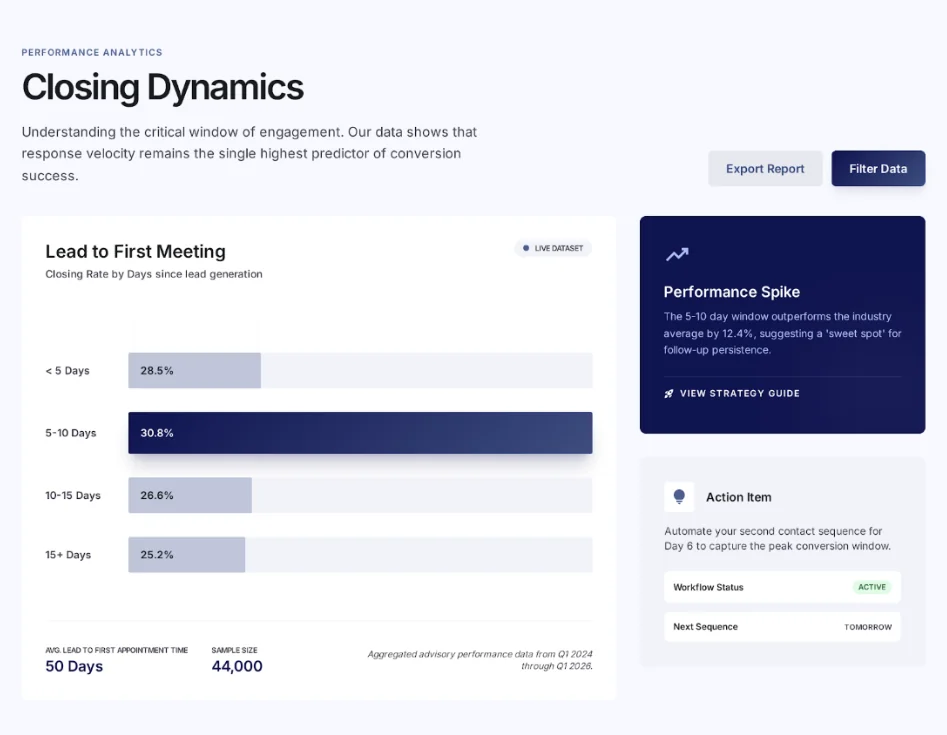
The first transition in the pipeline is the most time-sensitive. When we analyzed how quickly a lead moved from entering the system to sitting down for a first meeting, the pattern was immediate and clear:
- 5–10 days is the ideal window between receiving a lead and holding the first meeting, with a 31% closing ratio
- Leads that weren't booked until 15+ days after entry dropped to a 25% closing ratio
- Despite this, the average firm is holding that first meeting 50 days after generating the lead
- More than 65% of leads were being booked 15 or more days out
That gap between what the data recommends (5–10 days) and what most firms are actually doing (50 days on average) is significant. A 6-point difference in closing ratio at scale, across hundreds or thousands of leads, translates directly into lost revenue. For most independent financial advisor firms, that gap alone is one of the most immediate, fixable leaks in their client acquisition process.
Why This Happens
There are a few common reasons firms are slow at this stage. Some don't have a defined lead response protocol, so leads sit in a queue waiting for someone to act. Others have capacity constraints, the advisor or support staff responsible for outreach is stretched thin, and new leads get treated as a lower priority than existing client work.
In other cases, the delay is unintentional. The lead comes in, gets logged, and gets buried by the day-to-day. By the time someone follows up, the prospect has already moved on, or worse, connected with a competitor who moved faster. In a crowded market for independent financial advisor services, lead response time is increasingly a differentiator.
What This Means for Your Practice
Speed matters most at the top of the funnel. The first 10 days after a lead enters your pipeline is prime time, this is when the prospect's interest is freshest, their intent is highest, and your outreach feels timely rather than delayed.
Your team should treat new leads with the same urgency as a warm referral. That means having a defined process for lead outreach that kicks in within the first day or two, with a goal of booking the first meeting within that 5–10 day window. If your current average is closer to 50 days, that's not a scheduling problem, it's a pipeline management problem hiding in plain sight.
Stage 2: First Meeting to Second Meeting, Slowing Down (Slightly) Actually Improves Results
The Data
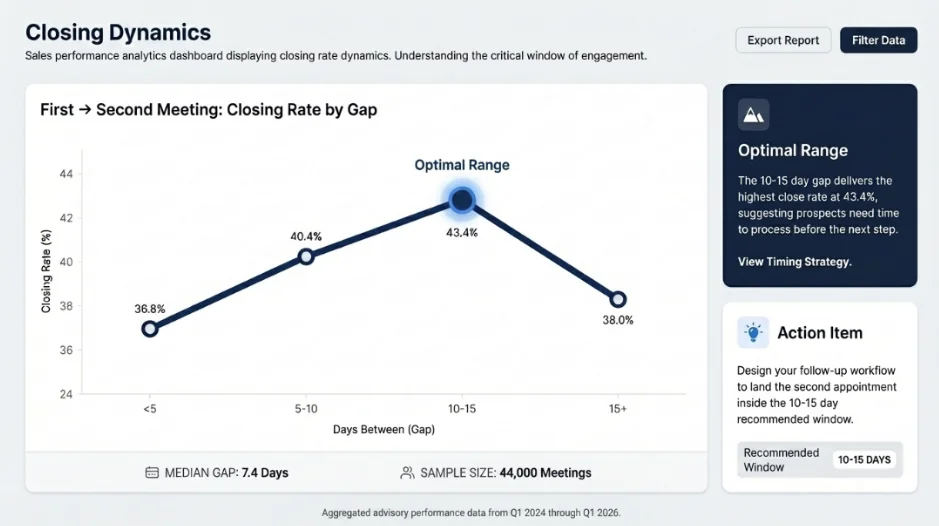
This is where the data gets counterintuitive, and where a lot of advisors are likely making a costly mistake without realizing it.
At this stage, the optimal timing is not "as fast as possible." The data shows:
- Closing ratios increase after five days between the first and second meeting
- 5–15 days is the optimal window between the first and second meeting
- Performance starts to drop again after 15+ days
This is one of the most actionable findings in advisor pipeline management: rushing the second appointment doesn't just fail to help your financial advisor closing ratio, it actively hurts it.
Why Rushing Backfires Here
There are two likely explanations for why speed is a liability at this stage.
The first is case preparation. Between the first and second meeting, a well-run advisory practice is doing meaningful work, analyzing the prospect's financial picture, developing initial recommendations, and preparing materials that demonstrate value. If the second meeting is booked within a day or two of the first, there may simply not be enough time to do that work well. A rushed second meeting with weak preparation can undermine the trust built in the first meeting, and trust is the foundation of client acquisition for financial advisors.
The second reason is prospect psychology. Financial decisions, especially ones involving transferring assets or changing advisors, are not made lightly. Prospects need time to process what was discussed in the first meeting, consider their situation, and come to the second meeting in a more decided frame of mind. Booking too quickly can make a prospect feel pressured, which creates resistance even when they were otherwise receptive.
A 5–15 day window gives your team time to prepare properly and gives your prospect time to move from "interested" to "ready." Both matter for your closing ratio.
What This Means for Your Practice
If your financial advisor sales process is pushing second meetings as quickly as possible in the name of urgency, you may actually be reducing your close rate. The goal at this stage isn't speed, it's readiness. Your team needs to be ready, and your prospect needs to be ready.
The 5–15 day window is entirely workable. That's not a slow process, it's a thoughtful one. Use that time intentionally: prepare your case, send a brief follow-up note after the first meeting, and let the prospect sit with the conversation before you bring them back in.
If you wait longer than 15 days without a second meeting scheduled, traction starts to fade. The data on this is consistent, momentum matters, just not at the cost of preparation and prospect readiness.
Stage 3: Second Meeting to Third Meeting, By Now, Timing Matters Less Than Commitment
The Data
By the third meeting stage, the advisor pipeline data tells a different story entirely:
- Closing ratios remain strong across all time ranges
- There is no clear penalty for longer gaps between the second and third meeting
- High-intent prospects are the priority, not compressed meeting schedules
Why the Dynamics Shift
By the time a prospect has been through two meetings, your pipeline has done its filtering work. The people who weren't serious have already dropped off. The people still in your sales process are genuinely evaluating your firm.
At this point, the question for your advisor prospect pipeline is no longer how fast are you moving? It becomes are they ready to decide?
The psychology shifts as well. A prospect at meeting three isn't going to forget about you because a week or two passed. They're in a different mental state than a brand-new lead. Pushing urgency at this stage is less necessary, and can be counterproductive if it makes a nearly-committed prospect feel rushed at the finish line. For independent financial advisors competing on relationship quality, this is an important distinction.
What This Means for Your Practice
At the third meeting stage, your energy is better spent on decision readiness than on calendar compression. Is the prospect clear on what they're deciding? Are their outstanding questions answered? Do they have what they need to move forward?
Focus on those questions rather than minimizing the number of days between meetings. The data supports a more patient approach here, and so does common sense about how high-trust financial relationships are built.
Actionable Takeaways for Your Advisor Pipeline
The data across all three stages points to a clear set of priorities for any independent financial advisor firm that wants to improve its closing ratio:
- Tighten your lead response window. Aim for a first meeting within 5–10 days of receiving a lead. The average firm is doing this in 50 days, which means most firms are leaving meaningful revenue on the table before the client acquisition process even gets started. Define a lead response protocol and hold your team accountable to it. This is one of the highest-ROI changes a firm can make to its financial advisor sales process.
- Stop rushing the second meeting. Give your team time to prepare, and give your prospect time to think. The 5–15 day window between first and second meetings is supported by the data and is entirely practical. Rushing this step doesn't just fail to help your closing ratio, it actively reduces your chances of closing. If your current process defaults to booking the second meeting at the end of the first, that may be worth reconsidering.
- Shift your focus at the third meeting stage. By this point in the advisor prospect pipeline, speed is no longer the primary variable. Prospect readiness is. Focus your energy on helping serious prospects get to a clear decision rather than on compressing the timeline.
- Measure your own timing as a KPI. Most financial advisor firms don't actually know what their average time between pipeline stages looks like. Your sales process may look very different than you assume. Tracking time-between-stages as a regular advisor KPI, and reviewing it alongside your closing ratio data, is the foundation for understanding where your process is working and where it's breaking down. What gets measured gets managed.
Final Thought: Rethinking "Time Kills Deals"
The independent financial advisors who consistently win new clients aren't simply the fastest ones in their market. They have a consistent sales process, and they track whether their team is actually following that process.
They understand one of the more nuanced truths in financial advisor business development: when to accelerate, and when to give space. Speed at the lead stage. Patience at the second meeting stage. Presence and clarity at the close.
Most advisor pipeline management content focuses on conversion rates, how many leads became clients. Fewer firms look at timing as a variable. But the data shows it's one of the most controllable factors in your closing ratio, and one of the most commonly mismanaged.
At Know Your Numbers™, we help financial advisors track not just what is happening in their pipeline, but why. The Know Your Numbers™ platform tracks RIAs and IARs across the country from lead to closed business, giving firms the visibility they need to stop guessing and start optimizing.
Because when you understand timing across thousands of real-world client journeys, you stop treating every stage the same, and start managing each one the way the data says to.