At Know Your Numbers™, we track advisor pipelines across independent firms. Here's what the data actually shows about junior advisor performance, and how it compares to the owners they work alongside.
Why this question matters
Hiring a junior advisor is one of the biggest leverage decisions an independent firm can make. Done right, it multiplies your capacity. Done wrong, it drains your time, your leads, and your optimism for three years before you admit it isn't working.
Most firms make this decision on gut feel, on what a peer told them at a conference, or on a compensation structure they copied from somewhere else. Very few make it on data, because very few have data.
We do.
Across junior advisors and owner/senior advisors tracked through Know Your Numbers™, here's what a year of production actually looks like.
What the numbers say
The data below covers full-year 2025 for most advisors. Where advisors are partway through 2026, we annualized their results based on pace through June 14. All figures represent annualized production.
Junior advisors: the median picture
At the median, a junior advisor's full year looks like this:
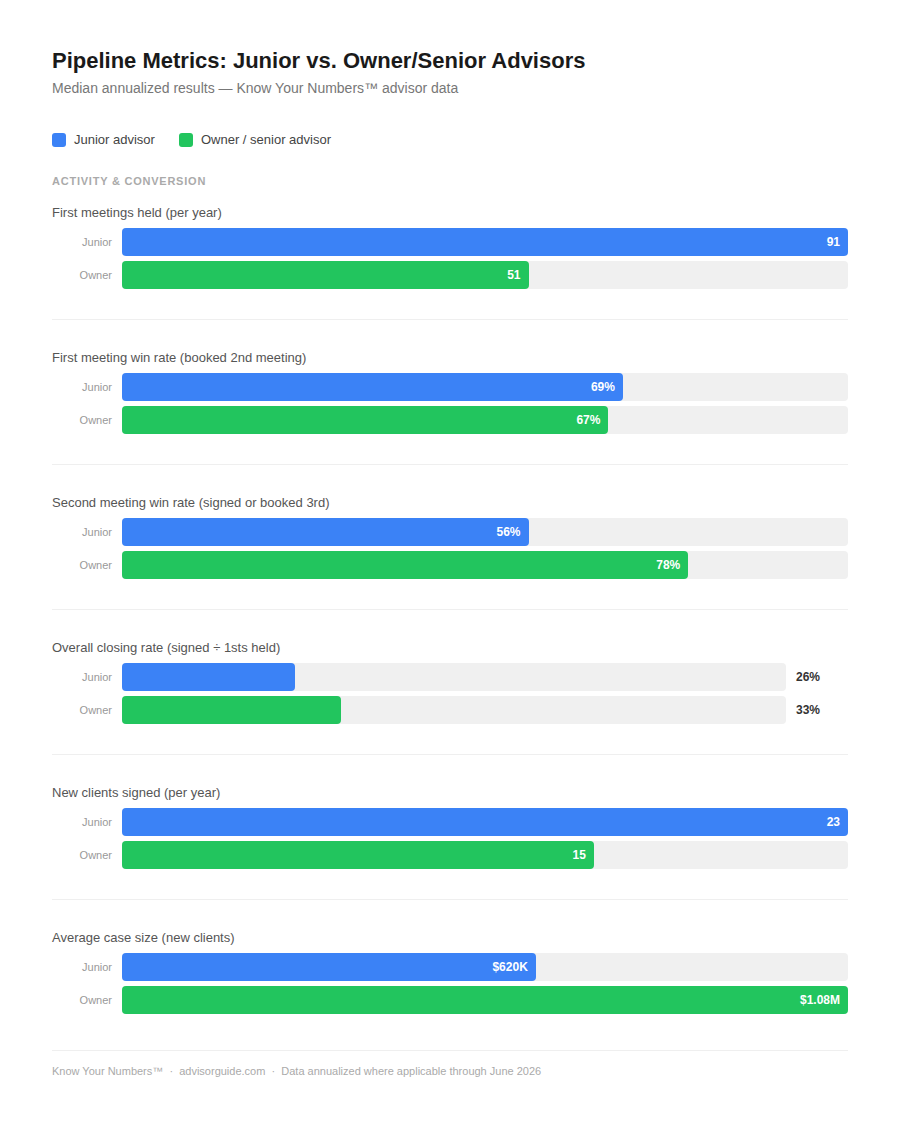
- 91 first meetings held
- 69% first meeting win rate (booked a second meeting)
- 56% second meeting win rate (moved to close)
- 26% overall closing rate (clients signed / 1sts held)
- 23 clients signed
- $14.1M in new production
- $19.4M in total production
- $620K average case size
That's the middle of the pack. The range, however, is wide. New production across junior advisors ran from $7.5M to $32.4M annualized. Total production ranged from $7.5M to $41.7M, the upper end reflecting advisors who had inherited or been assigned existing client books on top of their new business. Clients signed ranged from 6 to 47. Closing rates spanned from 11% to 58%.
Owner and senior advisors: a different profile
Owner-level advisors look meaningfully different in how they work, even if their production numbers don't always dwarf the juniors:
- 51 first meetings held (nearly half the volume of juniors)
- 67% first meeting win rate
- 78% second meeting win rate
- 33% overall closing rate
- 15 clients signed
- $11.0M in new production
- $37.0M in total production
- $1.08M average case size
The total production gap here tells the real story. Owners are sitting on established books, clients built over years, that generate production independent of new prospecting activity. The $37M median total reflects that accumulated base, not just what they closed this year.
Owners are also doing less prospecting volume but converting at a higher rate, and when they do sign a client, the average case is nearly double that of a junior advisor.
The core trade-off: volume vs. efficiency
This is the most important thing to understand when thinking about what a junior advisor brings to your firm.
Junior advisors hold more first meetings. They generate more top-of-funnel activity. They'll sit across from more new prospects in a year than most owners will.
What they don't yet have is the closing efficiency that comes with experience. At the median, a junior advisor closes 1 in 4 prospects they meet. An experienced owner closes closer to 1 in 3, on cases that are nearly twice the size.
That gap closes over time. But it doesn't close on its own. It closes because someone is running debriefs, reviewing second meeting performance, and tracking the numbers closely enough to know where to coach.
What to actually expect in year one
If you bring on a junior advisor and equip them with a steady lead flow, here's a grounded set of expectations based on the data:
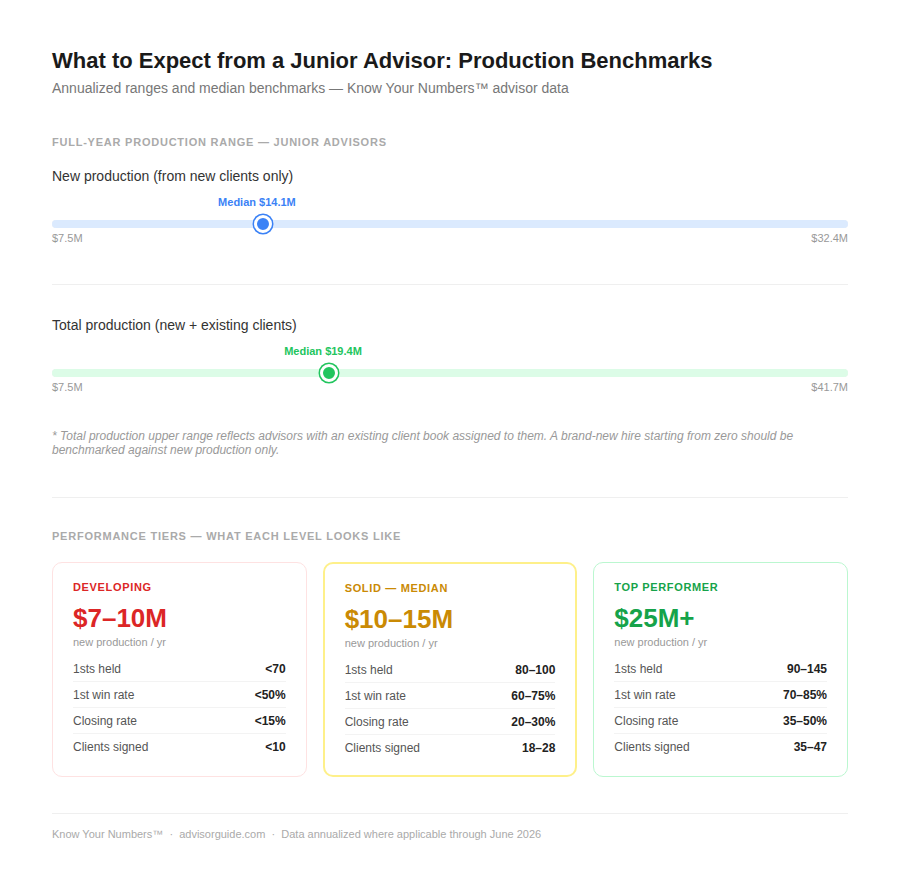
Meetings: Plan for 80 to 100 first meetings in their first full year. This assumes consistent lead sourcing from your marketing system. Junior advisors who underperform at the top of the funnel usually aren't the problem, the lead flow is.
Win rate: A 1st meeting win rate between 50% and 70% is realistic and healthy. Below 50% is a signal to examine how the first meeting is being run and what the expectations are going in.
Closing rate: 20% to 30% in year one is a reasonable benchmark. Below 15% is a red flag that warrants attention at the second meeting stage.
New production: $10M to $15M in new production in a full year represents a solid junior advisor performing near the median. Top performers in our dataset reached $30M+ in new production, but they combined strong conversion rates with high meeting volume. Volume alone doesn't get you there.
Total production: Expect $10M to $20M in total production in year one, assuming your junior advisor is starting from scratch with no existing book. The $19.4M median reflects a mix of advisors, some new-only, some with partial existing books assigned to them. A pure new hire with no carryover should be benchmarked against new production, not total. Once they have a year or two of clients behind them, total production becomes a more meaningful number to watch.
Average case size: Expect $500K to $700K per client at the median. Junior advisors tend to work with younger, still-accumulating clients. This isn't a flaw, it's a natural difference in relationship stage and referral network maturity.
A note on outliers
The range of outcomes in this dataset is wide enough that it's worth addressing directly.
On the high end, a small number of junior advisors produced $30M or more in new production in a single year. These aren't random, they share two characteristics: a very high first meeting win rate (80%+) and consistent pipeline volume. Efficiency and volume together drive the top results. Either one alone doesn't.
On the low end, a few advisors are sitting at closing rates below 12%. In those cases, the issue is almost always at the second meeting, prospects are coming back for a follow-up but not converting. That's a coaching and process problem, not a hiring problem. The data shows where it's happening. What happens next is up to the firm.
On the owner side, one team in our dataset produced over $100M in annualized new production. That outlier reflects a team structure and scale that is not representative of a single advisor's output. It reads as a different category of firm entirely.
What this means for your hiring decision
Hiring a junior advisor is not a plug-and-play decision. The data shows that the range of outcomes is enormous, and that range is almost entirely explained by two factors: lead flow and coaching quality.
The advisors performing at the top of this dataset are getting consistent meetings from a functioning marketing system, and someone is paying close attention to what happens in those meetings.
The advisors at the bottom aren't necessarily bad hires. They may be in firms where leads are inconsistent, where second meeting debriefs don't happen, or where nobody is watching the numbers closely enough to intervene. The same kind of process drift that quietly cut one firm's booking rate can sit undetected in a new advisor's pipeline for a full year.
That's what Know Your Numbers™ is built for. Not just to tell you what happened, but to show you, in real time, where things are slipping before a year's worth of production walks out the door.
Know Your Numbers™ helps independent financial advisory firms track pipeline performance from first meeting to closed client, so decisions about hiring, investment, and scale get made on real data, not gut feel. Find out if we're a fit.